-1.png)
How to Enjoy Bathing in Consistently Sparkling Clean Water?
A Bit of Alchemy, But No Rocket Science
The swimming season demands constant, perfect readiness from your garden pool for water sports, relaxation, fun, and enjoyment. For everyone to fully enjoy their time in the pool, the water's cleanliness and hygienic safety are just as important as a pleasant water temperature.
Water Filtration is Key
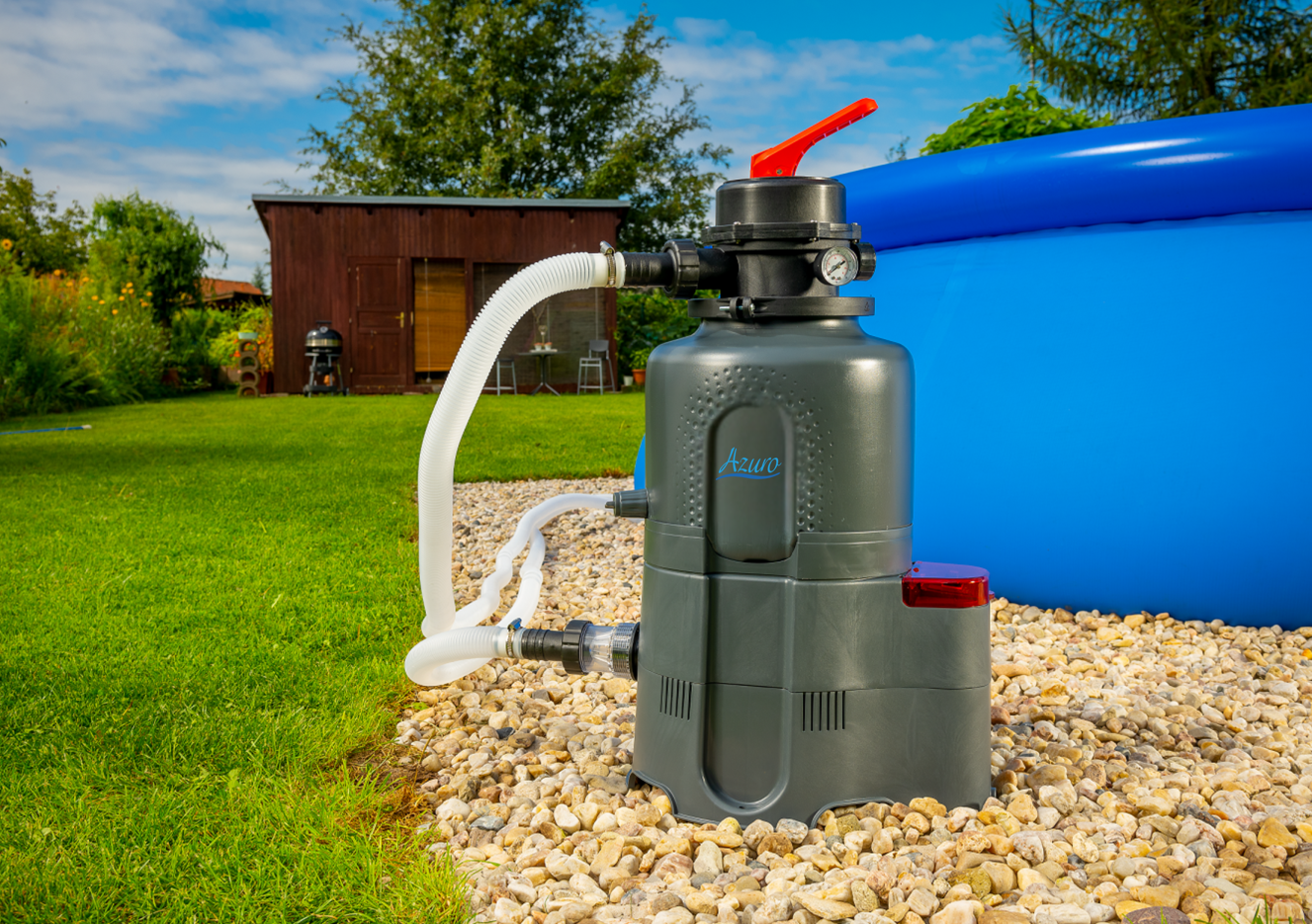
Sand filtration is the foundation of the system for achieving and maintaining high-quality, clean, and hygienically safe water. It removes impurities from the water, just like nature – it filters it, as the name suggests, through a sand bed. When choosing a suitable model, the pool's volume is the decisive factor. This determines the required pump output for effective filtration. The filtration system should be able to filter the entire pool volume within 3-4 hours. To perform its function perfectly, the sand media should be simply rinsed at least once every 14 days and replaced with new sand after every 2 seasons. For water filtration in some types of small above-ground pools, however, cartridge filtration is sufficient, which captures mechanical impurities on a filter cartridge.
Get a Vacuum on It!
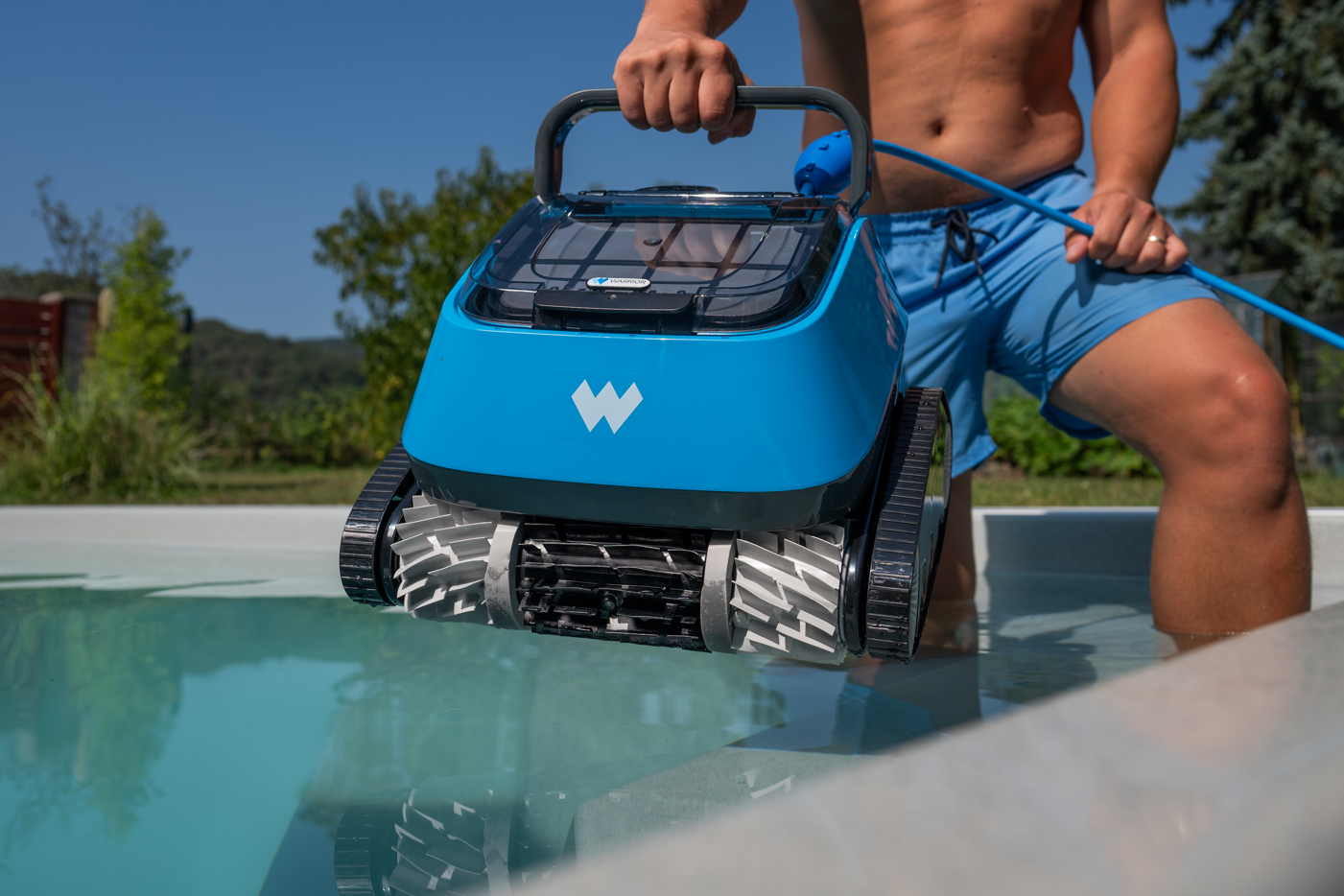
Relying solely on filtration for a perfectly clean pool isn't enough. Therefore, a pool vacuum cleaner regularly removes mechanical impurities and deposits from the pool walls and bottom. Without it, it's difficult to keep pool water in perfect condition. For luxurious in-ground pools and other types of pools with a larger surface area, automatic pool vacuums are ideal. Thanks to modern technologies, they are the most effective at taking care of the cleanliness of both the bottom and walls of the pool. Simply place them in the water, and they will quietly traverse the entire pool completely independently, even in your absence, and then automatically shut off. They have a programmable control unit for selecting the optimal mode, and they collect impurities, including microparticles, into an integrated basket. An option for above-ground and smaller in-ground pools are semi-automatic vacuums. They remove unwanted impurities from the pool bottom (some models also from the walls). They are easily connected to the sand filtration system without tools, utilizing its power for water suction and movement across the pool bottom (suction power increases with the sand filtration's performance). But it's also worth having one of the available nets with a telescopic pole handy by the pool at all times. With them, you can easily remove a leaf or sediment whenever needed, without having to call the vacuum into action immediately.
Alchemy Beneath the Surface
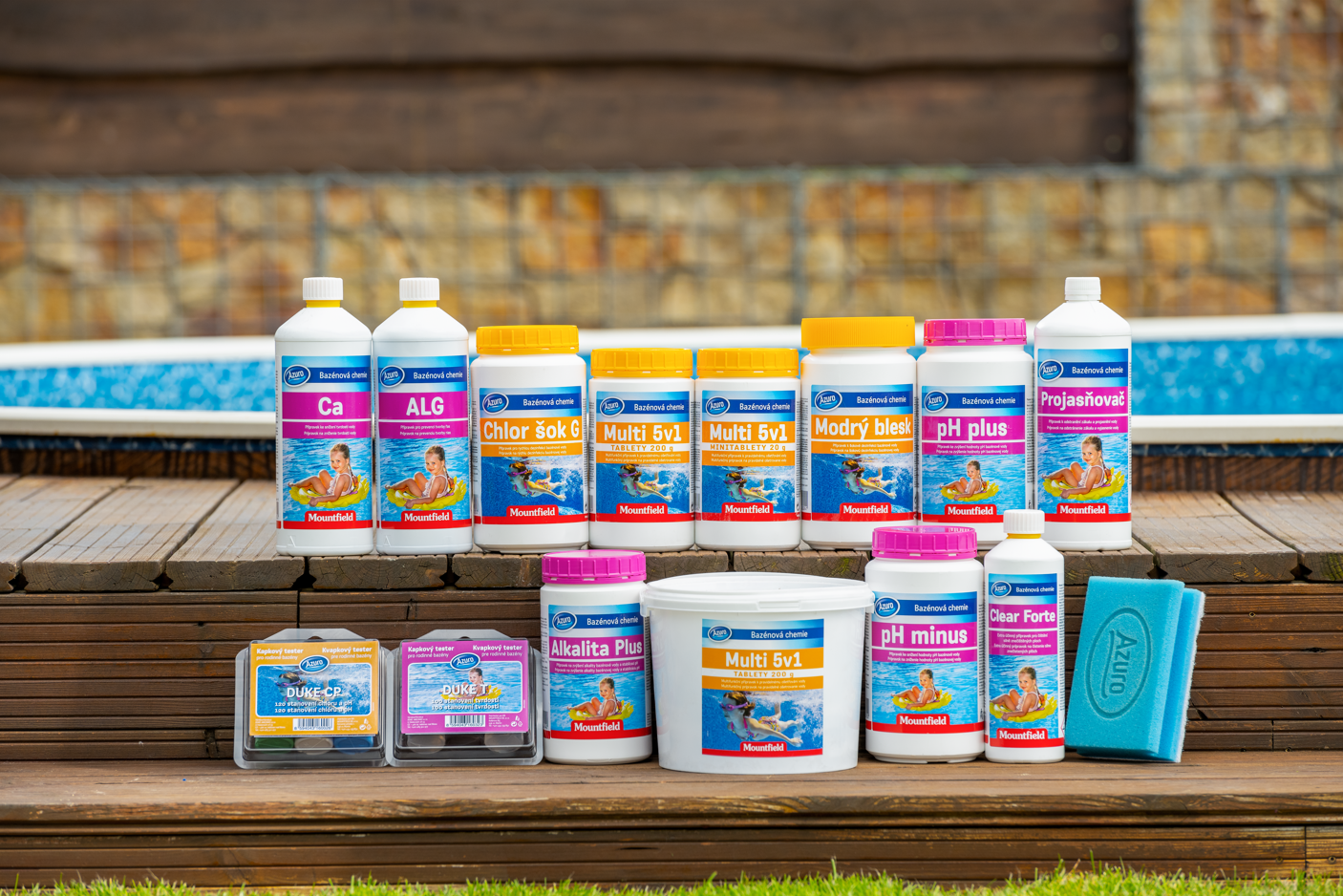
To perform any pool water treatment truly effectively, we should know the current values of its essential properties. These are acidity (pH), alkalinity, and hardness. A set of testers is a necessity for perfect pool care, and it's best to equip yourself with them right when you purchase pool water treatment products. A good pool specialist will advise and find a solution for restoring balance, optimal values, and water quality for every pool!
OPTIMAL VALUES OF MEASURED WATER PROPERTIES
-
Acidity: pH 7.0–7.4
-
Alkalinity: within the range of 80–120 ppm
-
Hardness: 8–18 °N
-
Free chlorine content: 0.3–0.6 mg/l
-
Active oxygen content: 4–20 mg/l
The pH value should be between 7.0 and 7.4. This range is hygienically safe and also ensures the effective action of all pool chemicals. A higher pH above 7.4 (alkalinity) can cause milky cloudiness of the water (calcium precipitation) or a chlorine odor. Conversely, a pH value below 7.0 (acidity) causes increased corrosion of metal parts of the pool and fading of colors of other materials. However, a pH fluctuation in both directions can also irritate eyes or skin. Therefore, check the pH value regularly, at least once a week, using a liquid or strip tester. In hot weather or if a large amount of impurities has entered the pool, measure the pH even more frequently.
With alkalinity in the optimal range of 80–120 ppm (carbonate balance), pool water is able to naturally balance and maintain the pH level. Deviation in both directions causes changes in the pH value, i.e., alkalinity or acidity of the water.
The hardness value of pool water should not exceed 18 °N. Hard water (e.g., well water) with a high iron and manganese content can turn brownish after disinfectant application. Special products therefore bind ions of these metals, preventing unwanted discoloration of the pool water. It is essential to remember to check and adjust water hardness throughout the entire season, and especially after refilling the pool.
Do Heat Waves Bother You? Thunderstorms and Downpours?
Does tropical weather have any impact on pool water quality? And what happens when thunderstorms and downpours arrive, will that affect the water too? Unfortunately, yes. Such weather, due to strong water evaporation that needs to be replenished, or conversely, heavy rainfall, can strongly shift the pH value. For example, rainwater typically has a pH value below 7.0, which is the lower limit for optimal pool water maintenance. During heavy rainfall, there is a significant drop in pH and consequently a higher risk of the water spoiling. Experts therefore recommend more frequent measurement and adjustment of pH values using dedicated products (e.g., Azuro pH plus and pH minus), to the optimal range of 7.0-7.4.
-
If strong thunderstorms and gales are threatening, it's worth turning off all electricity connected to pool operation. Make sure the filtration, lighting, and heat pump are not powered.
-
Never swim during a thunderstorm.
-
After a strong thunderstorm and downpour, check that all electrical components of the pool equipment are completely dry and fully functional. Otherwise, call a professional.
-
Remove impurities from the pool and adjust the pH.
4 STEPS TO CARING FOR CRYSTAL CLEAR WATER
-
Regular check of alkalinity and pH values
-
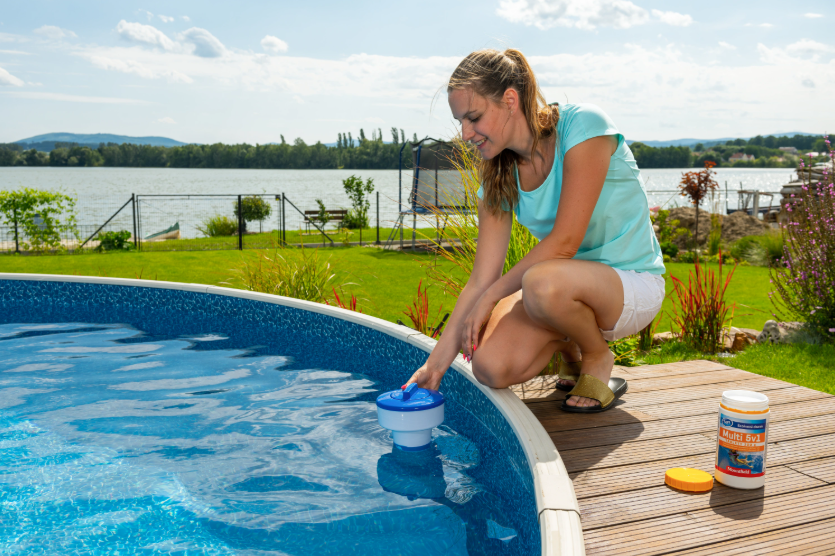
Water maintenance with special pool chemicals
-
Regular backwash of the sand filter media
-
Removal of coarse impurities with a pool vacuum or net
Maintaining pool water cleanliness is not just a matter of aesthetics, but also health. With modern pool vacuums, nets, and filtration systems, this maintenance is easier than ever before. Investing in the right equipment and regular care will ensure that your water oasis is a safe and pleasant place for relaxation and fun all year round. Let your pool shine with cleanliness and enjoy every moment spent in your personal piece of paradise.